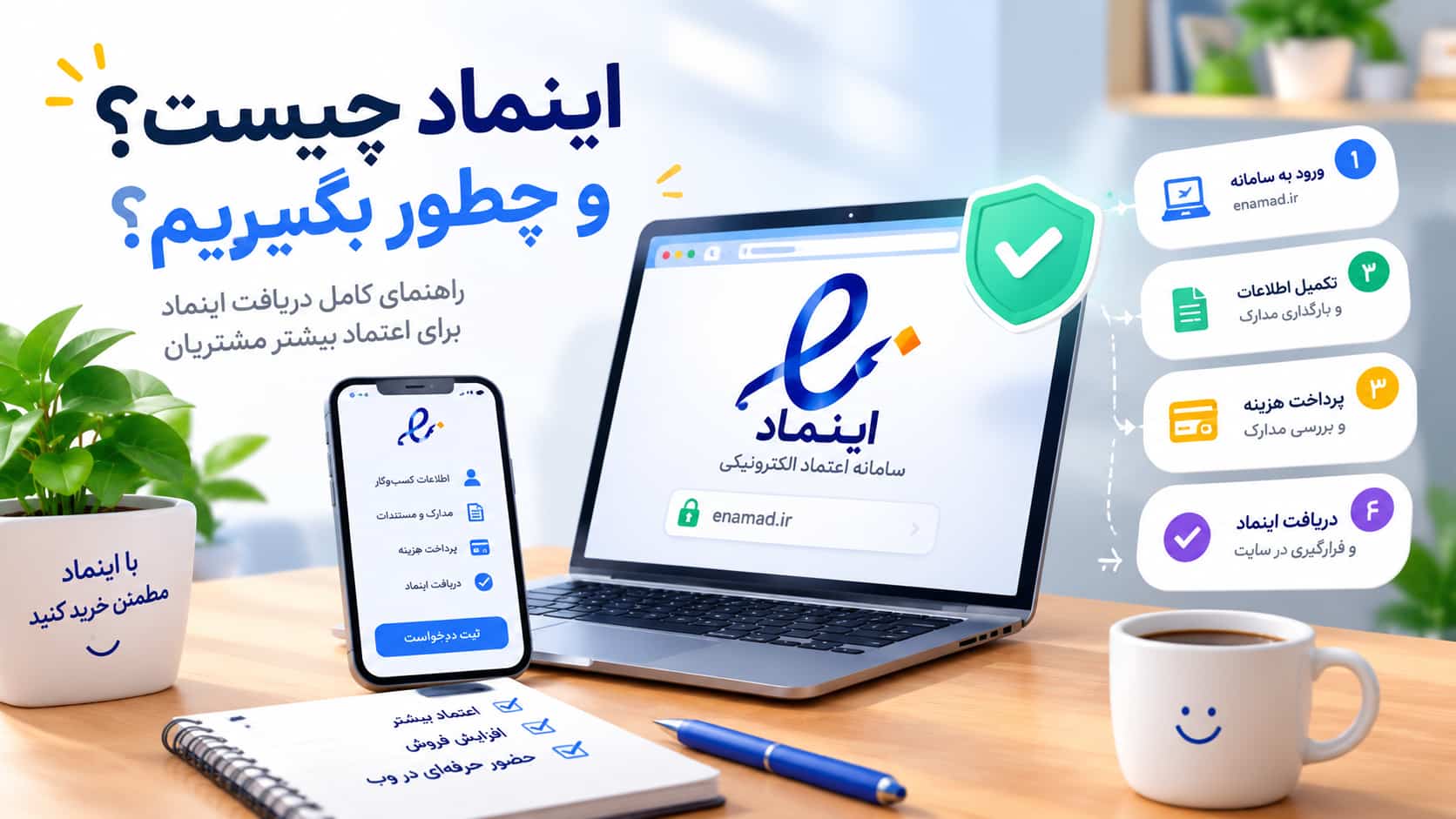
If you are about to sell online in Iran — or you work with an Iranian business that is — you will soon run into “eNamad”: the small badge at the bottom of Iranian online stores, and something payment providers there usually ask for before they will give you a payment gateway.
This guide explains in plain English what eNamad is, what it does and doesn’t verify, what a website needs before applying, and how the process works overall.
This guide was written in October 2026. eNamad’s rules and steps change from time to time; for current details, always check the official site, enamad.ir.
What is eNamad?
eNamad (Persian for “electronic trust symbol”) is a seal issued to online stores by Iran’s E-commerce Development Center, part of the Ministry of Industry, Mine and Trade. It is usually shown at the bottom of a site’s pages, and clicking it opens a page on the official eNamad site with the verified details of the site’s owner.
What does eNamad verify — and what doesn’t it?
eNamad confirms that the site’s owner is identifiable and accountable: their identity has been checked and their contact details and address reviewed. If something goes wrong, the customer knows who they are dealing with and where to complain.
It does not guarantee the quality of products or services. It only says that there is a known person or company behind the site.
Why does it matter for an online store?
- Payment gateways: Iranian payment providers usually require eNamad before granting an online payment gateway. Each provider sets its own exact conditions.
- Customer trust: many shoppers check the bottom of a site before paying. A missing seal — especially on a store they don’t know — makes them hesitate.
If you currently sell through Instagram and want to take payments online, see also a website for your Instagram shop.
What your website needs before you apply
eNamad is issued to a website, not to an Instagram page, and most rejected applications fail because of the site itself. Before applying, make sure that:
- The domain is registered in your name; the domain owner’s details should match the applicant’s.
- The site is complete and live, not “coming soon”: products are shown with clear prices and the checkout works.
- There is a contact page with an address, phone number and email.
- There is an about page that makes clear what the business is.
- Terms of purchase are published, covering shipping, returns and privacy.
- Your details match everywhere: the name, address and phone on the site are the same as in your application.
- What you sell is permitted.
The process, in outline
- Sign in and verify your identity on the official eNamad site.
- Enter your details as an individual or a company, with your contact information.
- Register your domain and prove you own the site — usually by placing a code or file eNamad gives you on the site.
- Confirm your contact details, such as phone, email and address.
- Expert review. If anything is missing, you will be told so you can fix it.
- Receive the seal’s code and add it to your site, usually in the footer of every page.
The details of each step, the documents required and how long review takes may change; read the current guidance on the official site before you start.
What do eNamad’s stars mean?
eNamad has several levels, shown as stars. Businesses usually start at the first level and can move up over time, with a longer track record and further documents. Check the exact criteria for each level — and which level a given payment provider accepts — with the official eNamad site and the provider.
Common reasons applications are rejected
- An unfinished or “coming soon” site
- No contact page, about page or terms of purchase
- The domain owner’s details not matching the applicant’s
- The address or phone on the site differing from the application
- Product prices not shown
How a web developer can help
The application is made in the business owner’s name, so you have to submit it yourself. But your web developer can make it much easier: building the contact, about and terms pages from the start, delivering a complete checkout that can be tested, placing the ownership-verification code on the site, and preparing a spot for the seal in the footer.
At Bambo Web we do all of this as part of building an online store, so your site is ready for eNamad from day one. To see what a store would cost, try our price calculator or read our guide to e-commerce website design.
Frequently asked questions
Can you sell online in Iran without eNamad?
Technically yes, using direct card-to-card bank transfers. But getting a payment gateway is usually not possible without it, and new customers are less likely to trust the store.
Can an Instagram page get eNamad?
eNamad is issued for a website’s domain, so you need a website to get it.
How long does it take?
It depends on how complete the site and documents are, and on the review queue. The more complete your site is before you apply, the less back-and-forth there will be. Check the official site for current review times.
Does eNamad need renewing?
Yes. It is valid for a limited time and has to be renewed when it expires. Note the expiry date so your site’s seal doesn’t lapse.
Summary
eNamad shows that there is an identifiable, accountable business behind a website. In Iran it is usually needed for a payment gateway, and it makes new customers more willing to buy. The most important step is preparing the site itself: a domain in your name, contact, about and terms pages, and the same details everywhere.
If you’d like an online store built ready for eNamad and online payments from day one, ask us for a consultation.